
How to Check Criminal History in Saline County
Begin with the event you need to prove. A filed misdemeanor, traffic infraction, ordinance case, or felony preliminary hearing belongs in Saline County Court. A felony trial file belongs in District Court. Both courts use Nebraska's JUSTICE case information services, and both have counters at the courthouse in Wilber. A recent arrest or present jail stay starts with the Saline County Sheriff. An official statewide Nebraska Record of Arrest and Prosecution comes from the Nebraska State Patrol Criminal Identification Division.
Bring a full name, likely spelling variants, a date range, and a case or incident number when known. Date of birth helps distinguish people in a state repository search, but public court access may expose fewer identifiers. Each result needs to be tied to the right person and read through its final disposition. A booking charge is not the final filed charge.
- Identify whether the source should be the sheriff, County Court, District Court, or the Nebraska State Patrol.
- Search JUSTICE by party name and select Saline County, or use a free courthouse terminal in Wilber.
- Call the sheriff for current custody because Saline County has no verified public jail roster.
- Read the docket through the disposition, judgment, sentence, and later orders rather than stopping at the first charge.
- Request a certified copy from the proper clerk or order an official NSP report when that specific product is needed.
Note: A negative result from one Saline County record channel does not prove that every other official system is clear.
Three Saline Records, Three Answers
Saline County criminal records do not form one master public file. A sheriff booking marks intake and custody at one point in time. A JUSTICE case shows what the County Attorney filed and how the court acted. An NSP report compiles eligible adult Nebraska fingerprint-based arrests and reported dispositions under state dissemination rules. The arrest allegation may change before filing, and a court result may reach the state repository later.
The official Saline County government homepage shows how local offices are divided within county government.
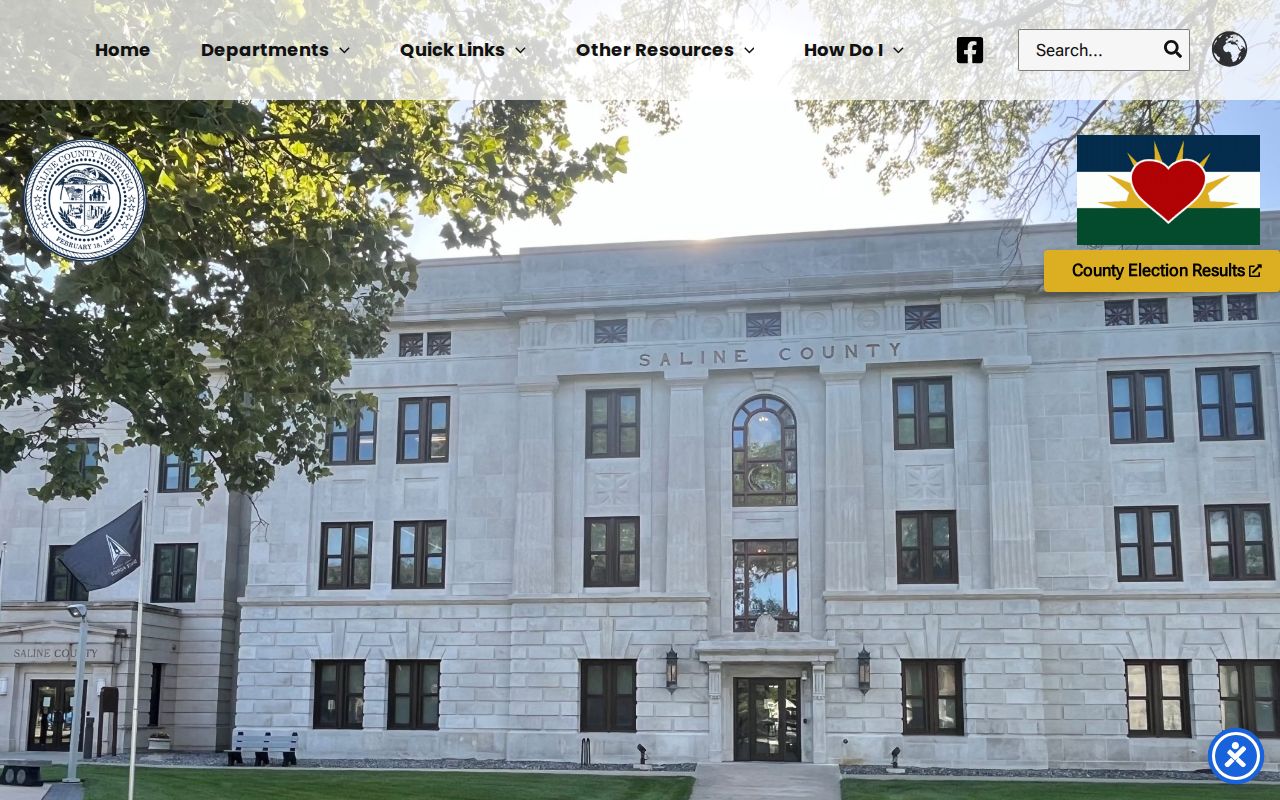
The county navigation is useful for finding the office that created a record, while court and state systems supply the other layers.
| Source | Best answer | Key limit |
|---|---|---|
| Saline Sheriff and jail | Incident, arrest, booking, custody, and warrant material | Does not prove the final court outcome |
| JUSTICE and court clerks | Filed charges, events, orders, disposition, and financial entries | Protected cases and fields are withheld |
| Nebraska State Patrol CID | Reportable Nebraska arrest-and-prosecution history | Not an FBI report or a substitute for each local file |
Official Nebraska Background Checks
The Nebraska State Patrol, Investigative Services Division, Criminal Identification Division maintains the central repository. Its Nebraska Criminal History Reports portal accepts public name-based requests. The current charge is $30 per person and is nonrefundable even when no record is returned. The transaction asks for requester details, then the subject's first and last name, birth date, sex, and race. A Social Security number, driver-license number, and residence may help narrow a match when accurately known.
The portal moves through Requestor Information, Person(s) of Interest, Payment, and Result. It accepts major payment cards and times out after one hour of inactivity. Keep the receipt number. Completed reports stay available for retrieval for only 14 days. A clear no-record response may be ready at once, while an uncertain match can take an NSP technician up to three business days to research.
Fingerprint-supported review gives a stronger identity match. NSP accepts fingerprint-based requests, and law-enforcement agencies can provide fingerprint cards. Call the Saline County Sheriff at 402-821-2111 to confirm local availability and any rolling charge. The FBI Identity History Summary is a separate, subject-only national process that requires fingerprints.
| Official channel | Published cost | Access point |
|---|---|---|
| JUSTICE one-time name search | $17, up to 30 cases, three-day view | Online through Nebraska Judicial Branch |
| Courthouse JUSTICE terminal | Free search | Public terminal at a Nebraska courthouse |
| NSP name-based history | $30 per person, nonrefundable | Online or current NSP paper route |
| FBI Identity History Summary | $18 base fee | Subject-only electronic or mail request |
| County Attorney pending-case copies | $0.25 per page | Special discovery rules apply |
Saline Criminal Records at Two Buildings
Two Wilber addresses divide the local record trail. The Saline County Courthouse at 204 South High Street holds County Court, District Court, the County Attorney, and Probation District 1. The Law Enforcement Center at 911 South Main Street holds the Sheriff, communications, and county jail. A request mailed to the wrong building can be delayed, and each uses a different post office box.
The official sheriff page identifies the Law Enforcement Center and describes the sheriff's jail role.
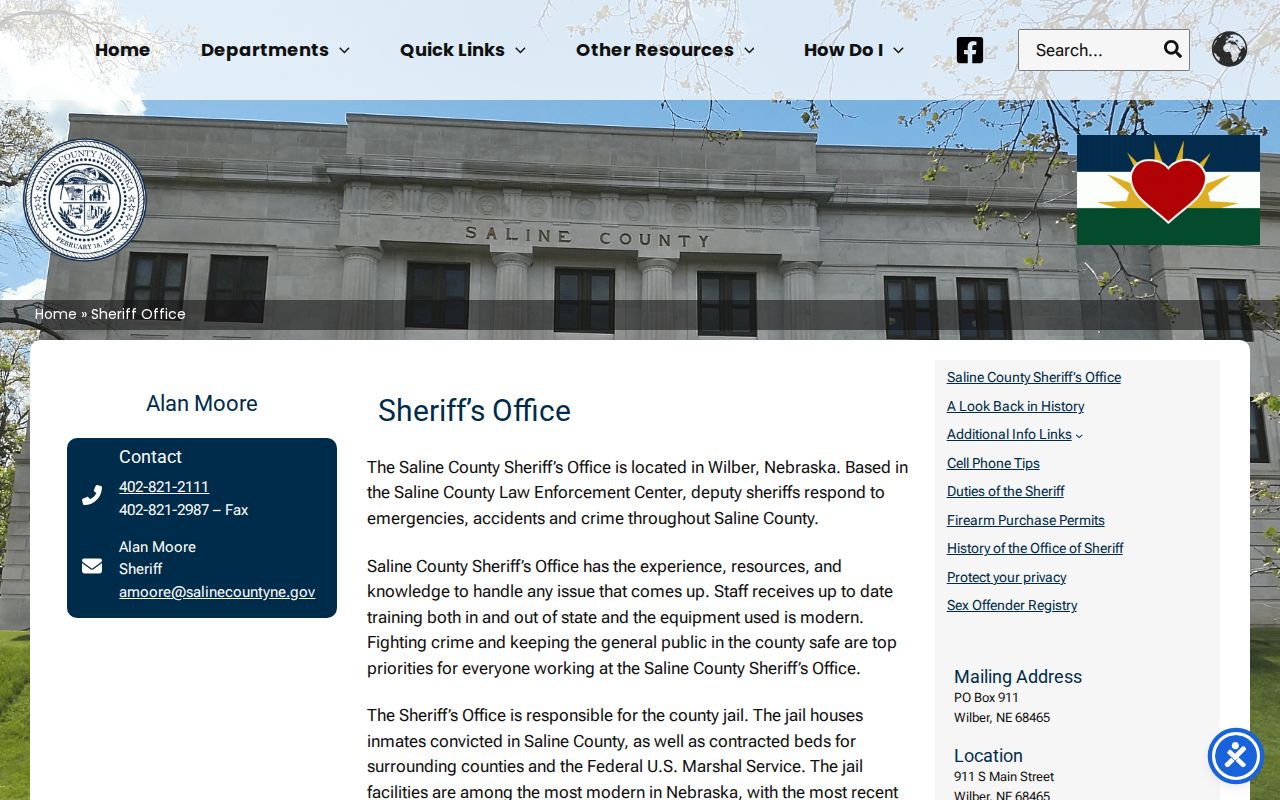
That office is the practical first call for current custody, recent booking facts, sheriff-created reports, and releasable warrant information.
Courthouse Record Counters
204 S. High St., Wilber, NE 68465
District Court: 402-821-2823
County Court: 402-821-2131
Law Enforcement Center
911 S. Main St., Wilber, NE 68465
Sheriff and jail: 402-821-2111
County Clerk Routing
204 S. High St., Wilber, NE 68465
402-821-2374
clerk@salinecountyne.gov
Types of Criminal Records
An incident report records an agency's investigation and allegations. An arrest report adds the legal basis, officer, time, place, and alleged offense. Jail staff then create a booking file with intake data, fingerprints, photograph, bond, custody, and release activity. None of those entries is a judgment. The County Attorney's complaint or information is the formal charge, and the clerk's court file shows how it ended.
Saline County criminal history also spans warrants, probation, parole, prison custody, and the Nebraska Sex Offender Registry. These are purpose-built records. An NDCS incarceration result concerns state prison custody, while the Saline jail holds local, contract, and some federal prisoners. Physical presence in that jail does not show that Saline County filed the charge.
- Disposition
- The court's outcome for a charge, such as conviction, dismissal, or acquittal.
- Bind over
- The transfer of a felony from its County Court preliminary stage to District Court.
- Register of actions
- The dated list of filings, hearings, orders, and other case events.
- Set aside
- Nebraska relief that notes rehabilitation but does not erase the historical case file.
Saline Criminal Record Custody Paths
Use the custody agency that matches the stage. The Saline jail is the local source for a person held before trial or serving a county-jail term. The Nebraska Department of Correctional Services inmate search covers state prison incarceration. The Federal Bureau of Prisons locator covers federal custody. Since Saline houses some contracted prisoners from nearby counties and federal prisoners for the U.S. Marshals Service, the jail location alone does not identify the arresting agency or court.
The record flow is best read as a short chain: Arresting agency → Saline booking when detained locally → County Attorney charging choice → County or District Court → NSP disposition reporting. A person can leave that chain before a case is filed, and a filed charge can differ from the booking entry.
For current Saline County jail custody, call 402-821-2111. No official searchable local roster was found. For an older booking, request the record from the sheriff under the county public-record route. Visitation, mail, phone, deposit, and identification rules should also be confirmed with the jail because reliable public details were not posted.
What a Saline County Criminal Record Shows
The fields depend on the custodian. A repository history groups identifying data, aliases, arrest cycles, reporting agencies, charges, dispositions, and later custody or supervision. A court file adds the case number, filing date, judge, parties, motions, orders, register of actions, financial assessments, and public document images. Booking files are strongest on intake and short-term custody. Public views remove protected identifiers and confidential material.
| Name and identifiers | Legal name, aliases, birth data, and other matching details allowed in that product |
|---|---|
| Arrest and booking | Date, agency, alleged offense, intake number, bond, custody, and release event when maintained |
| Charges and statutes | Initial allegations or the separate charges formally filed by the prosecutor |
| Case events | Filings, hearings, pleas, motions, judicial orders, and register entries |
| Disposition | Conviction, acquittal, dismissal, diversion result, or another charge-level outcome |
| Sentence or supervision | Jail, prison, probation, parole, restitution, fines, and later relief when public |
Match these Saline County record fields across sources before treating two entries as the same event. Names alone can create a false match.
Read Saline Criminal Case Events
A JUSTICE register line needs context. A complaint marks an accusation. A hearing entry proves that an event was set or held, not that a charge ended a certain way. An order shows judicial action. The disposition and judgment resolve the filed count, while later orders may change status or note relief. A warrant entry may be historical, so current status should be confirmed with the issuing court or sheriff.
A one-time search can return up to 30 cases and remains viewable for three days. Subscribers can narrow by court type, case subtype, county, year, judge, attorney, exact case number, or judgment date. Public kiosks provide free access. Clerks can help locate a specific file when given a complete name, case year or type, and preferably a case number, but they do not perform broad background research.
For charges, pleas, final disposition, and sentencing documents, the fuller Saline County criminal court case record is the right follow-through after an arrest entry.
Public Access Laws
Nebraska law starts with a right to examine and copy public records, but access is not absolute. The office holding a Saline County record may redact protected information, withhold a confidential case, or restrict active-investigation material. A written request should name the agency, date range, person or location, incident or case number, and desired format. Narrow terms make the search faster and reduce review cost.
Key Nebraska laws and rules:
Neb. Rev. Stat. § 84-712 provides the basic right to inspect and copy public records as state law allows.
Neb. Rev. Stat. §§ 84-712.01 to 84-712.09 address definitions, exemptions, costs, response duties, and enforcement.
Neb. Ct. R. § 6-1701 et seq. governs public access to trial-court records and protected information.
Neb. Rev. Stat. § 29-3523 limits public dissemination of specified criminal-history information.
Neb. Rev. Stat. § 29-2264 authorizes a sentencing court to set aside a qualifying conviction.
A custodian must answer a written request within four business days by producing records or an estimate, citing a statutory denial, or giving a written extension and earliest practical date. Nebraska residents receive the first eight cumulative staff hours for search, identification, physical redaction, and copying without a salary charge. A deposit may be required when estimated copies exceed $50.
Route Saline Criminal Record Requests
Saline County has no single online form for all criminal records. Send sheriff-created incident, arrest, dispatch, booking, jail, and warrant requests to the Sheriff at South Main. Send court-file requests to the clerk for the court that handled the case. If the record holder is not clear, the County Clerk at High Street will route the request to the proper county department.
The county limits ordinary charges to actual duplication, material, and equipment-maintenance costs and gives an estimate before work continues. No sheriff-specific flat report price, fixed turnaround, or published ID rule was located. Ask for electronic delivery, an advance estimate, and segregation of public from exempt material. This is often more useful than asking for every record tied to a broad name.
Pending criminal discovery follows a different route. The Saline County Attorney's official page identifies the office and its prosecution programs.
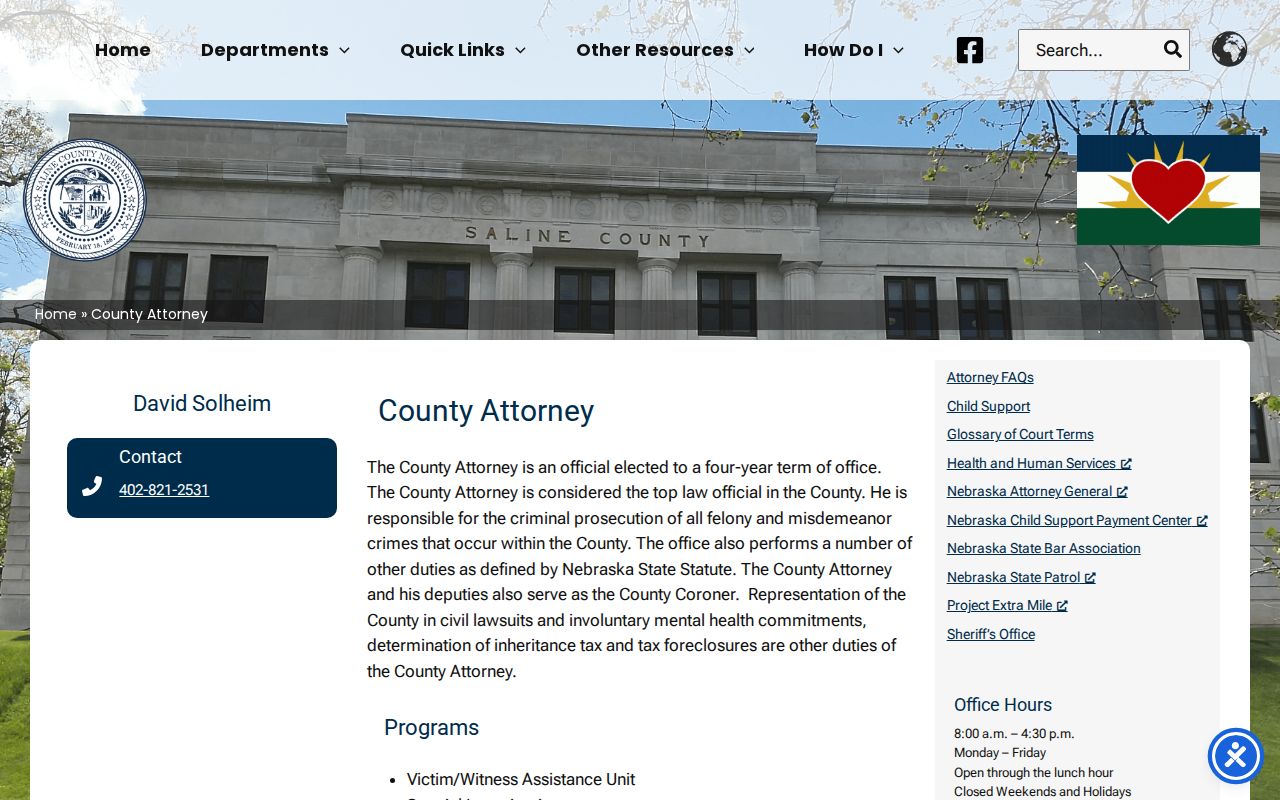
Represented defendants obtain pending-case reports through counsel and court process, while a self-represented defendant follows the office's stated post-arraignment, photo-ID rules.
Sealed, Expunged & Restricted
Nebraska generally calls qualifying conviction relief a set aside. Under § 29-2264, a person applies to the sentencing court after completing the sentence. The judge considers statutory factors and rehabilitation. A granted order records the relief and nullifies the conviction for specified purposes, but it does not erase the historic Saline County case file. The term expungement can therefore misstate what happened.
Juvenile cases, sealed matters, victim and minor information, personal identifiers, and parts of an active investigation may be closed or redacted. Nonconviction dissemination also depends on the outcome and elapsed time. Nebraska limits ordinary public repository disclosure for certain no-file, diversion, prosecutor-dismissed, acquitted, and qualifying program-dismissed matters.
For self-review, identify the exact County or District Court file, get the final disposition, and use current Judicial Branch forms or self-help material. After an order is entered, obtain a certified copy and allow agencies time to process it. Then recheck JUSTICE and order an NSP report. If the state history remains wrong, contact the agency that supplied the disputed arrest or disposition so it can correct the data sent to NSP.
When Saline Criminal Records Disagree
A mismatch often has a routine cause. The arresting officer may list an initial offense that the County Attorney later changes or declines to file. A court may dismiss one count while another remains. NSP may not yet have received the disposition. Aliases, spelling changes, and weak identifiers can also split or confuse results. No single Saline County criminal history source should be used to guess the missing step.
First, save the booking or repository result that seems wrong. Next, locate the court case and certified disposition. Compare the event date, agency, charge, and case number. If the court is right but NSP is not, contact the contributing arresting or reporting agency. NSP's correction chain depends on that agency confirming and supplying the fix. If no case appears, ask the arresting agency whether the person was released without filing and allow for data lag or restricted information.
Note: A court-certified dismissal or set-aside order helps identify an error, but the contributing agency still drives an NSP correction.
Saline Probation and Diversion Records
Probation is a Nebraska Judicial Branch function, not a sheriff program. Saline County belongs to Probation District 1, and its local office shares the courthouse at 204 South High Street. The sentencing docket is the best place to verify a probation order. Supervision details should not be assumed public. Parole is different: the Nebraska Board of Parole decides release and related actions, while the Division of Parole Supervision manages community supervision.
The official Probation District 1 directory lists the Saline County contact.
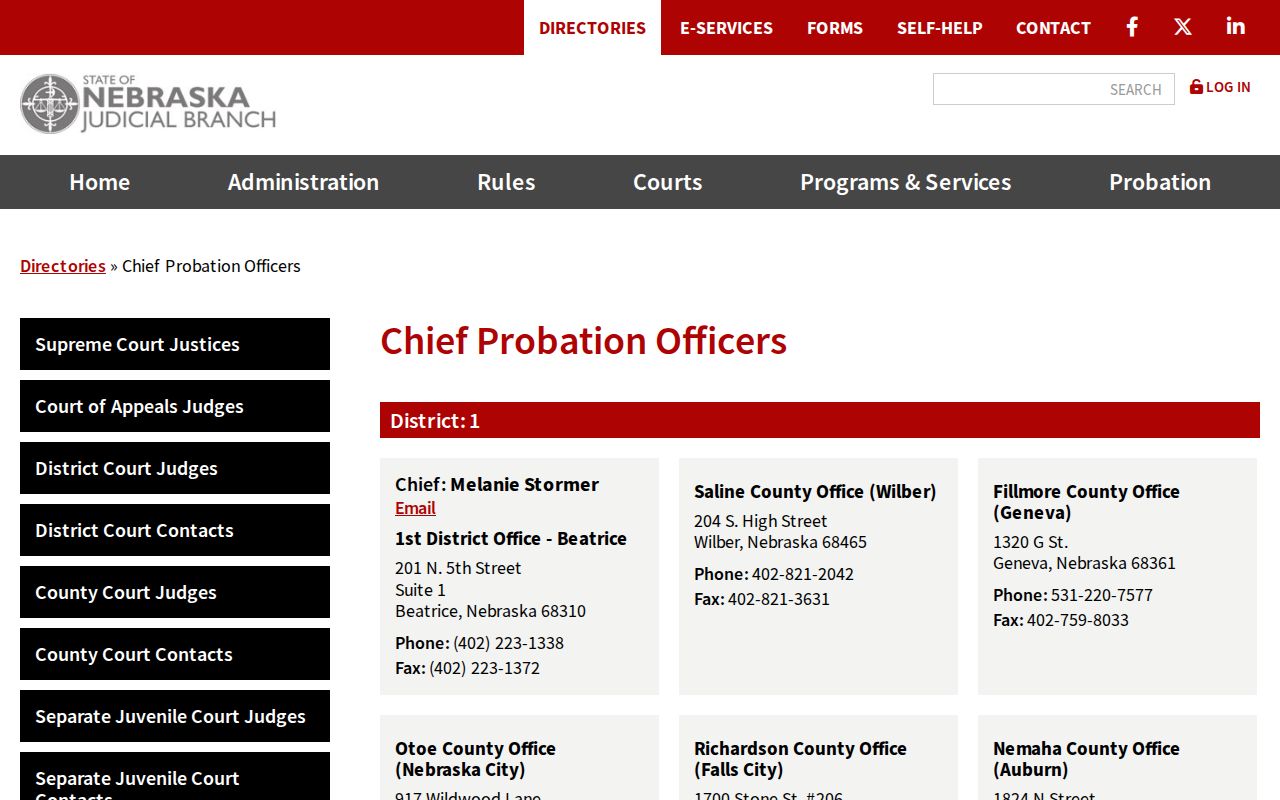
The local probation office can be reached at 402-821-2042, but the court file remains the public source for the sentence and later filed orders.
Saline County also hosts the Southeast Nebraska Adult Drug Court. Judicial Branch reports describe repeated graduations at the Saline courthouse, including events in 2025 and 2026. The program uses at least 20 months of treatment and supervision, with testing, incentives, and sanctions. County Attorney programs also include Diversion and Victim/Witness Assistance. These programs help explain why a docket can show a supervised treatment path rather than only a standard jail, prison, or probation sentence.
Criminal Records by City in Saline County
Crete, Wilber, and Friend are Saline County's three largest incorporated cities by the official 2020 Census ordering. The Census QuickFacts county profile supplies broader population context. Their local channels differ. Crete and Friend retain police contacts, while current Wilber pages identify the Saline County Sheriff as the city's law-enforcement provider. Nebraska does not operate a separate municipal court in any of the three. Ordinance, traffic, and misdemeanor cases route to Saline County Court, and felony trials move to District Court.
Crete Criminal History
Population 7,099. Crete Police creates local reports; county courts in Wilber hold filed cases.
Wilber Criminal History
Population 1,937. The Sheriff provides current city law enforcement and operates the county jail.
Friend Criminal History
Population 954. Friend Police writes local reports, while detention records belong to the county jail.
Saline Criminal Records Beyond Wilber
A Crete or Friend police contact may create a city report, then lead to a Saline booking and a court file in Wilber. The city record and county record answer different questions. Wilber differs because the Sheriff is the current law-enforcement provider. City administrative requests still go to each city office, but sheriff, jail, and court records stay with their own custodians. The official Crete homepage is the source for the largest city's local government access.
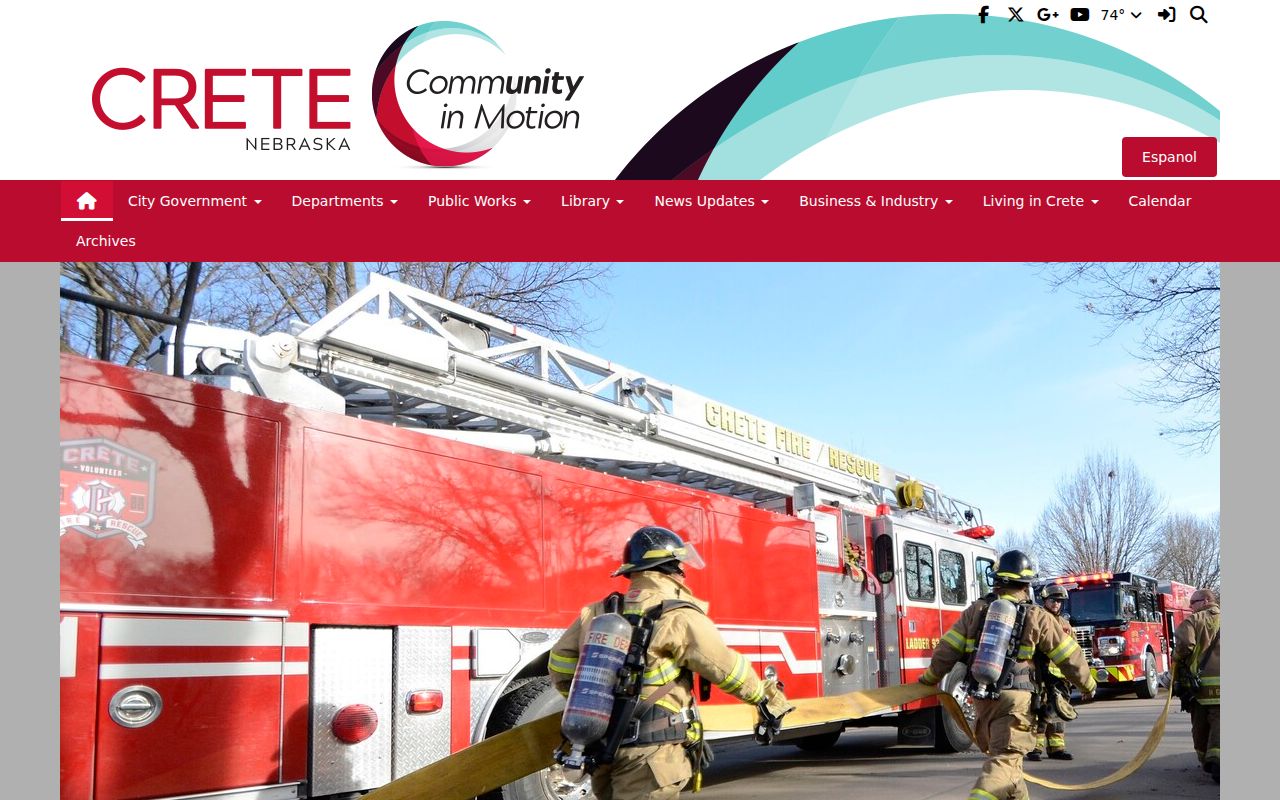
Crete Police reports begin at the city level, while a booking and final court outcome are checked through Saline County offices in Wilber.
The official Friend homepage supplies the third-largest city's government contact point.
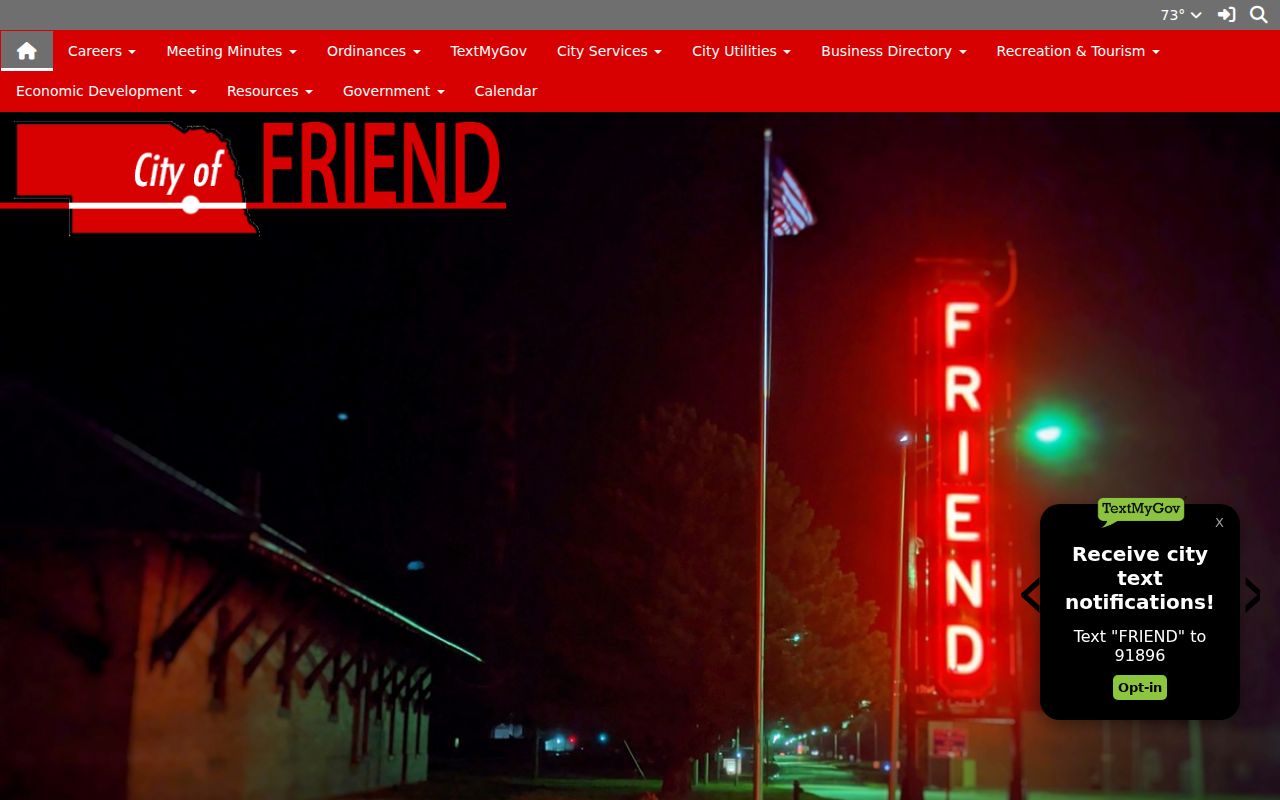
Friend's police line is monitored by the Sheriff, but the city still lists its own police staff and sends detainees to Saline County custody.