
Criminal Cases in the Saline County Courts
Saline County criminal court cases divide by charge level. County Court hears misdemeanors, infractions, ordinance prosecutions, and the preliminary stage of felony matters. Saline County has no separate juvenile court, though juvenile records follow stricter access rules. A felony that is bound over after a preliminary hearing, or filed directly at the higher level, proceeds in District Court for arraignment, motions, trial or plea, and sentence. The two clerk counters share the Saline County Courthouse at 204 S. High Street in Wilber, yet each maintains its own part of the record.
The Saline County Court can explain access to a specific misdemeanor or preliminary-hearing file at 402-821-2131. The Clerk of District Court is the custodian for felony dockets, filed papers, orders, judgments, costs, restitution, and certified copies. City ordinance charges also belong in County Court's stated jurisdiction. A reader should not search for a separate Crete, Wilber, or Friend municipal-court database.
The county's official court page shows how these jurisdictions meet. Its source view is available from the County Court jurisdiction and contact page.
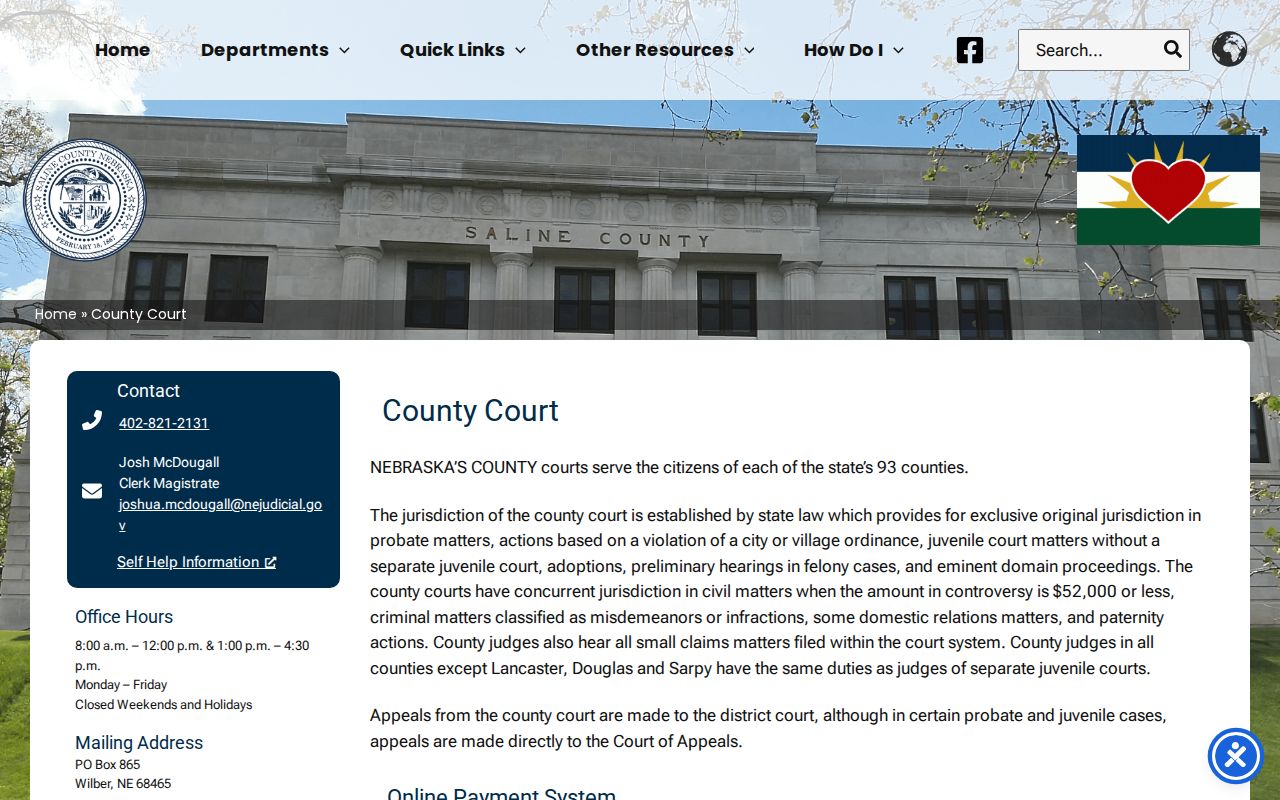
This court-level split is the first choice a Saline County case searcher must make.
Saline County Felony Record Counter
The District Court clerk's counter is the local source for a filed felony case. The Judicial Branch Saline District Court listing confirms the court contact. It is open from 8:00 a.m. to noon and 1:00 to 4:30 p.m. on weekdays. Call 402-821-2823 before visiting, especially for an archived file. Nebraska court policy allows staff to help locate a specific record when the requester supplies a full name, case year or type, and other useful detail. It does not require staff to conduct open-ended name research.
The Clerk of District Court page documents felony jurisdiction and the public counter.
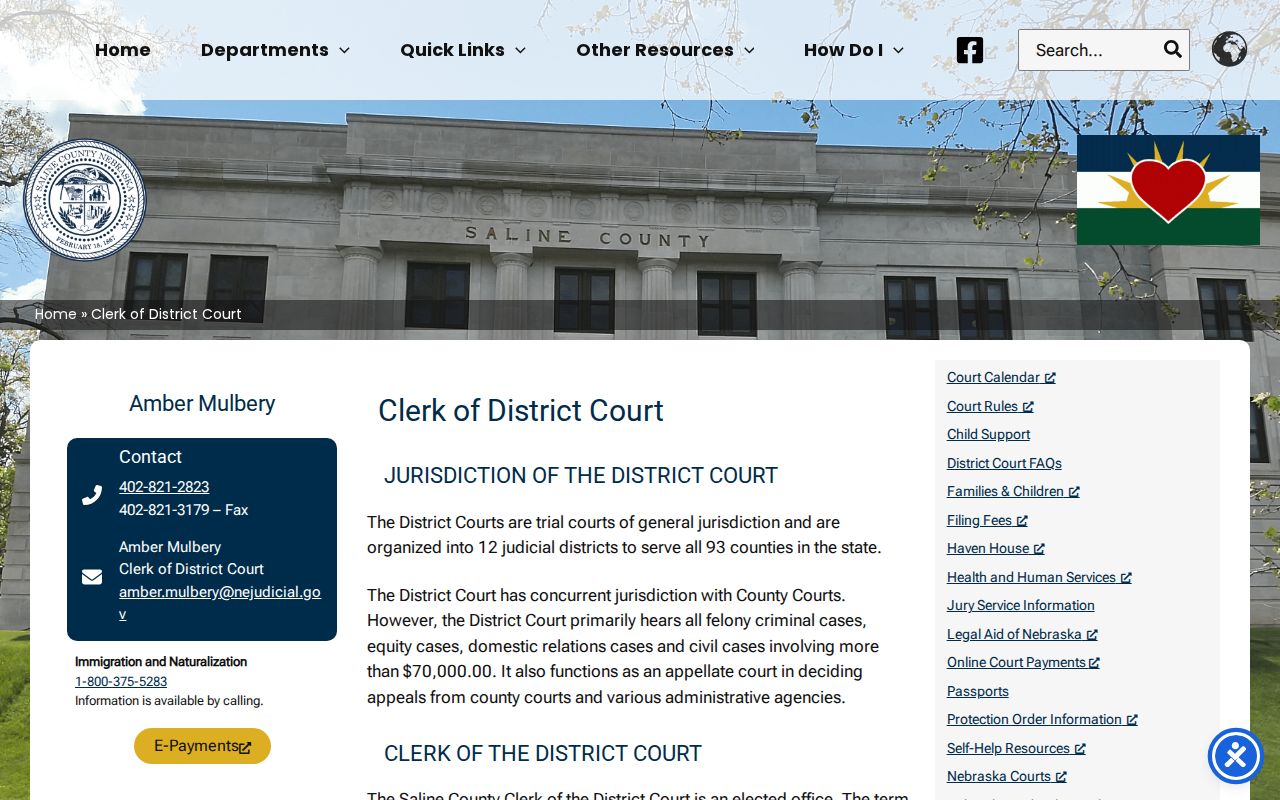
That distinction matters when a broad JUSTICE result must be turned into a copy request. A case number lets the clerk retrieve the exact Saline County file and quote costs under the current statewide court fee schedule. The research does not provide a Saline-specific flat copy fee, so ask the clerk for the current amount instead of relying on an old quote.
How to Search Case Records
The Nebraska Judicial Branch offers three practical paths into Saline County court records. The one-time JUSTICE party-name search currently costs $17, returns up to 30 cases, and remains available for three days. JUSTICE subscribers pay an annual account fee and small charges for some detail searches. A public courthouse terminal supplies free JUSTICE access. The counter remains the fallback for a known case, a certified copy, or older material that is not available as a clickable image.
- Choose County Court for a misdemeanor, infraction, ordinance case, or felony preliminary proceeding. Choose District Court for the felony trial file.
- Open JUSTICE case information eServices, use the party-name route, and select Saline County when the screen offers a county filter.
- Enter a complete last name and first name. Add court type, case type, filing year, judge, attorney, or exact case number when known.
- Open the case summary and register of actions. Read the filed charge, each court event, and the final disposition together.
- Give the correct clerk the case number when requesting a paper, certified copy, or archived Saline County court file.
The Judicial Branch explains how the paid, subscription, and free courthouse channels compare.
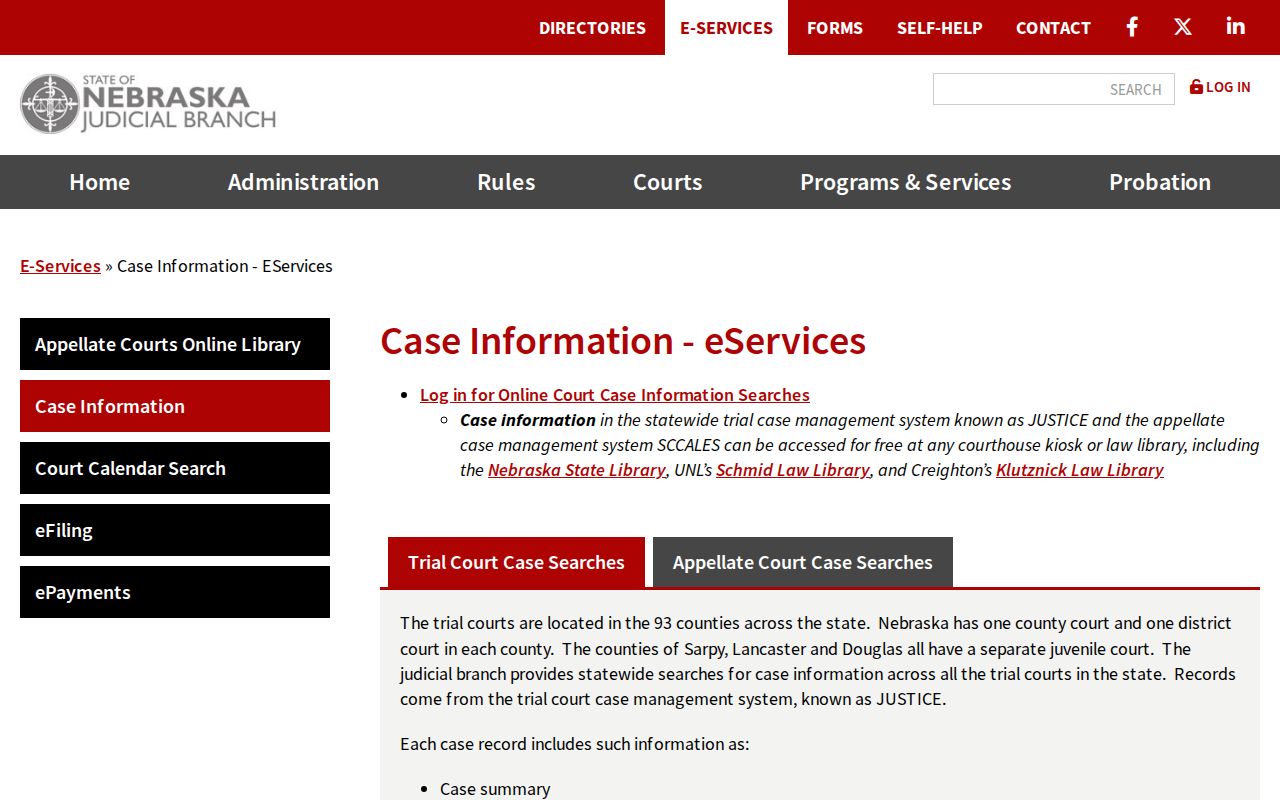
The image reinforces why remote access is only one part of a complete Saline County court-record search.
| JUSTICE field | Input | Required | Use |
|---|---|---|---|
| Party or last name | Text | Name route | Starts a party search; use a complete name |
| First name | Text | Not stated | Narrows common-name results |
| Court type and county | Dropdowns | Optional | Select County or District and Saline |
| Case type and year | Dropdown or number | Optional | Limits the filing category and period |
| Case number | Text | Route-specific | Opens the exact file when known |
| Judgment date | Date | Subscriber route | Finds results by judgment timing |
Saline County Felony Transfer
A felony may first appear only in County Court. That is not necessarily a missing District Court record. County Court handles the initial appearance, bond, and preliminary hearing. If probable cause is found, the matter is bound over, meaning transferred for District Court proceedings. A later District Court record may use a different case number and may reflect charges changed by the County Attorney.
When the felony trail seems to stop, read the County Court register for a bind-over or dismissal entry. Then search District Court by the same party name and a close filing period. If the online chronology remains unclear, provide both case numbers to the two clerks. The filed complaint or information controls the prosecuted charge, not the intake label from an arrest. This is also where the broader Saline County arrest history and the court case file part ways.
Note: A hearing entry proves that an event was scheduled or held, not that the charge ended in a particular result.
What the Case File Shows
A Saline County criminal case file is a sequence of official court acts. The case summary identifies the court and status. The charging paper states the formal accusation. The register of actions lists filings, hearings, and orders by date. Financial records may show costs, restitution, assessments, receipts, and amounts paid. Public electronic images can include filed papers, but protected identifiers and confidential records are withheld or redacted.
| Case Number and Court | Case type, filing year, sequence, Saline County court level, status, and assigned judge. |
|---|---|
| Charging Document | The complaint, information, or indictment stating the filed allegations and statutes. |
| Docket Entries | The dated register of actions for filings, motions, hearings, orders, and notices. |
| Parties and Counsel | The State and defendant roles plus attorneys of record in the public view. |
| Disposition and Judgment | The outcome of each charge, such as conviction, acquittal, dismissal, or other court action. |
| Sentence and Finances | Sentence terms, court costs, restitution, assessments, and payment entries when public. |
Read the disposition, judgment, and sentence as separate parts. A dismissal ends a charge without a conviction. An acquittal is a not-guilty result. A plea is the defendant's formal answer, while a plea agreement is a negotiated proposal that still requires court action.
Reading Saline County Case Entries
JUSTICE can show more than the final result. Its financial and action fields help explain what happened between filing and closure. “Arraignment” is the hearing where a plea is entered. “Disposition” means the outcome. “Restitution” is a court-ordered payment for victim loss. “Concurrent” terms run together, while “consecutive” terms run one after another. A stale warrant line may be historical, so current status must be confirmed with the court or Sheriff.
- Complaint
- An initial sworn charging document.
- Information
- A felony accusation filed by the prosecutor.
- Bind over
- Transfer of a felony from County Court to District Court.
- Register of actions
- The dated list of filings, hearings, and court orders.
- Set aside
- Nebraska relief that notes rehabilitation but does not erase the case history.
These terms keep a Saline County docket from being read as a single yes-or-no record. The charge line, event sequence, disposition, and judgment must agree before drawing a conclusion.
Stages of a Criminal Case
The County Attorney decides whether and what to file after an arrest or citation. Misdemeanors stay on the County Court track. A felony uses County Court for its preliminary phase and then District Court after bind-over or direct filing. Motions and discovery come before a plea or trial. The court then enters a disposition and, after a conviction, a sentence. Appeals create a further record outside the initial trial-court sequence.
Case flow: Charges Filed › Arraignment › Pretrial › Plea or Trial › Disposition › Sentencing
Each stage leaves a different entry. A filed charge is an accusation. A motion is a request for a ruling. A verdict or accepted plea may support judgment, while the sentencing order states the court-imposed result. This order of events is why Saline County court records should be read from the start through the last action.
Saline County Drug Court Records
The Saline District Courthouse is a recurring site for Southeast Nebraska Adult Drug Court. Judicial Branch reports from 2025 and 2026 describe graduations there, with a program that lasts at least 20 months and uses treatment, supervision, testing, incentives, and sanctions. This is a problem-solving court track for qualifying nonviolent drug-related participants, not a separate public case database.
A participant's underlying charge and court orders remain tied to the correct Saline County case. Search JUSTICE by the case identifiers, then read the docket for orders and the final disposition. Program news can explain local court practice, but it cannot establish the outcome of an individual file. The Judicial Branch report on the May 2026 Saline graduation supplies official context for the regional program.
Saline County Federal Court Cases
An event in Saline County does not ensure a state-court filing. A federal prosecution has its own docket in the U.S. District Court for the District of Nebraska and is accessed through PACER after registration. JUSTICE will not supply that federal case merely because conduct occurred within the county.
The U.S. District Court for the District of Nebraska identifies the federal court and its official services.
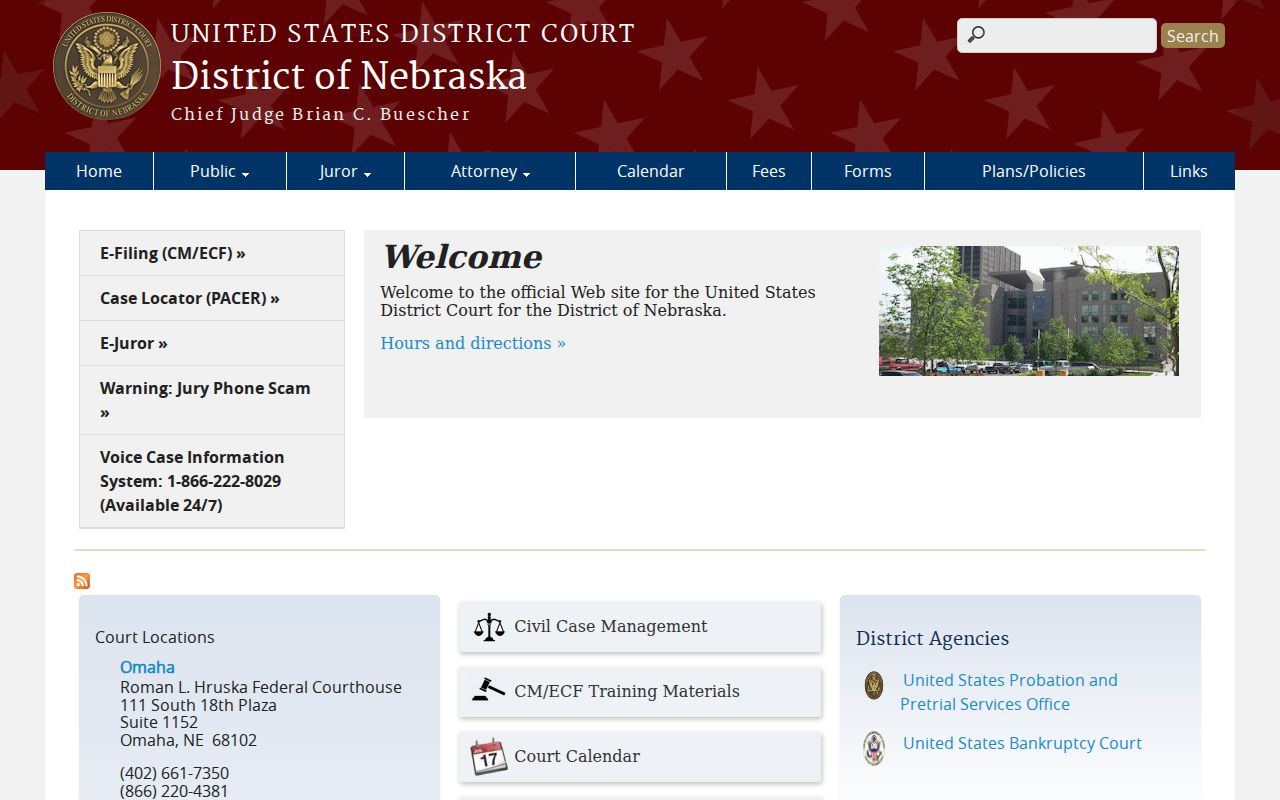
This separate layer helps explain why a Saline County name search in JUSTICE can be silent even when a federal docket exists. Federal copies and fees follow PACER rules, not the Saline County clerks' process.
Access & Restrictions
Nebraska law presumes access to public records, and Nebraska court rules govern trial-court access. Still, juvenile cases, sealed matters, protected victim or minor information, private identifiers, and confidential filings may be unavailable or redacted. The online view can therefore contain less than the full court file. A missing result may also reflect spelling, an alias, the wrong court level, a non-electronic archive, or a case that was never filed.
For an older or absent Saline County criminal case, start with a precise request to the correct clerk. Include the case number when possible, full name, court level, case type, and approximate year. Ask whether the record is archived, sealed, destroyed under an applicable rule, or simply unavailable online. The Nebraska court-record search policy and the county's District Court access explanation confirm that staff can direct access to an identified public record but do not conduct broad criminal-history research.
Nebraska's set-aside law is one reason an old case may show later relief without vanishing. The official text of Neb. Rev. Stat. § 29-2264 explains the sentencing court's authority.
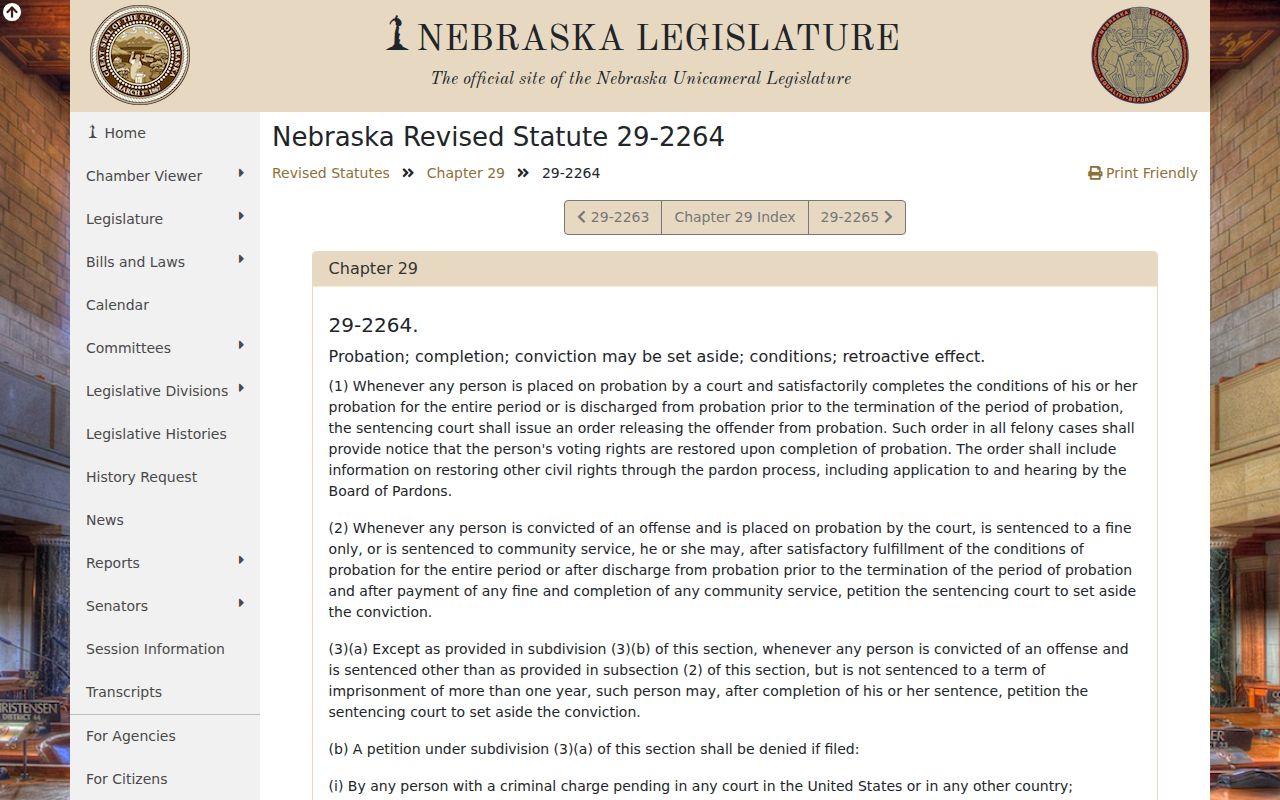
A granted set-aside records statutory relief and does not erase the historical Saline County case file.